
Follow the Barber County Address-to-Owner Route
One name on one screen is never enough. The smart approach links three records so each backs up the others. Begin with the CIC public appraiser search, which takes an address or an owner name and returns the parcel identity. From there, check the parcel in county GIS and pull the newest recorded deed. Together they answer who owns the land according to current Barber County records.
- Enter the situs address in Barber County Appraiser public access. Try only the street number or a shortened street name if the full address fails.
- Save the PIN, Quick Ref, legal description, and owner-of-record name. These are stronger cross-system keys than an address alone.
- Open the linked GIS or tax record to make sure all systems point to the same parcel.
- Ask the Barber County Register of Deeds for the newest deed or an index check, then compare its grantee and legal description.
This route has a real advantage. It reports ownership as the county itself records it. It also keeps a path open to recorded proof through deed records. That matters. An occupant, a taxpayer, or a stale mailing contact can all look like an owner without holding title. The linked public CIC parcel detail shows the county record used at the first step.
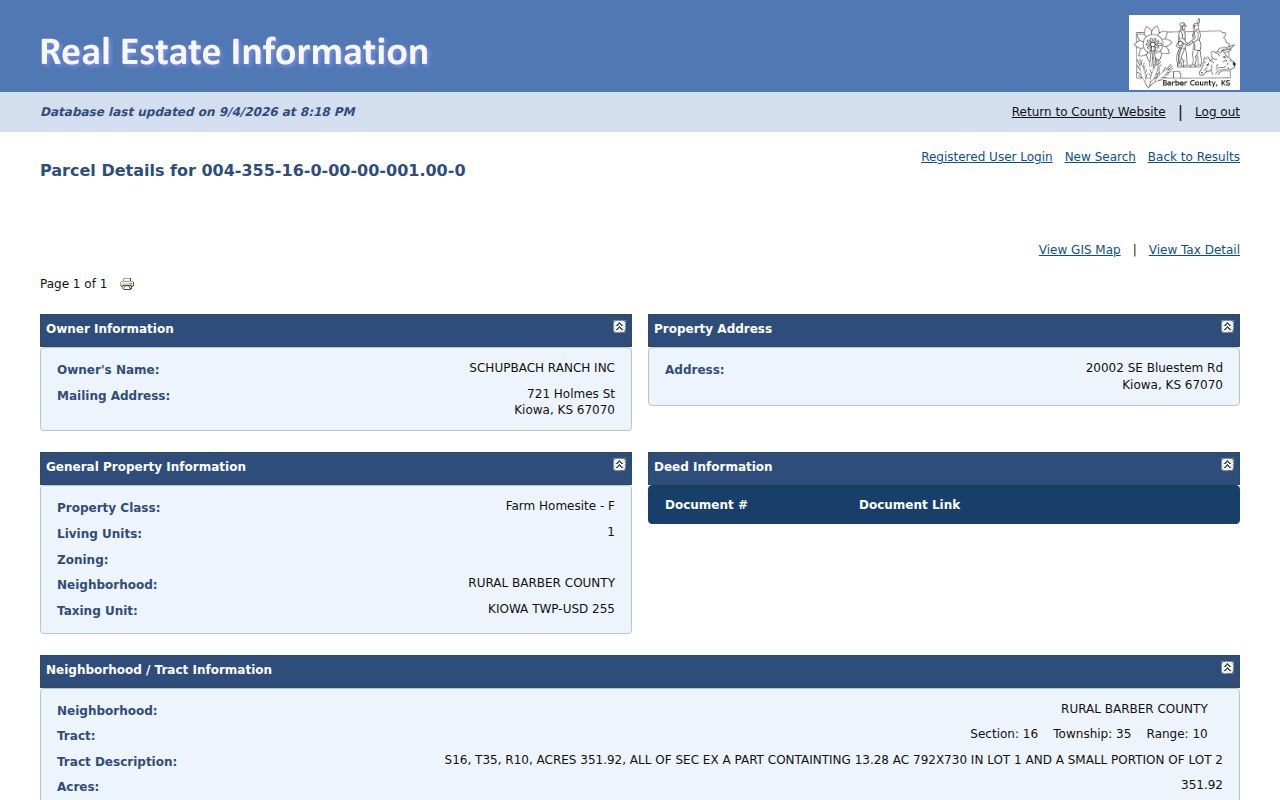
Treat the parcel keys and owner fields on that screen as leads, then finish with the deed-confirmation step.
Read Barber County Owner and Address Fields Together
Barber County GIS labels its fields plainly: OwnerName, OwnerAddr, and SitusAddr. The owner name is who the parcel record lists. The owner address is where official mail goes. The situs address is where the land or building actually sits. Those two can differ for good reasons. Agricultural ground, entity-owned buildings, estates, and owners who get mail elsewhere all produce a split between mailing address and property address.
Four terms carry the load here. Owner of record is the name on the county roll, while a grantee is the recipient named in a deed. Situs is the physical property address. Mailing address is where notices go, and none of these alone amounts to a title opinion.
Copy the spelling exactly as the record shows it. Initials and entity suffixes matter. A small name variation can decide whether a later deed or a business-entity search turns up anything at all.
PIN and Quick Ref Keep the Parcel Identity Straight
Alongside the legal description, the parcel tools display a PIN and a Quick Ref. Keep both. They keep the parcel identity straight when similar addresses collide. They also help when a rural tract has no street address at all. Barber County CIC also lets you search by Parcel ID, CAMA, legal description, acreage, property class, and subdivision. Those alternate routes rescue a stalled property search when an address lookup misses. The public GIS parcel layer adds direct CIC and tax hyperlinks. That bridge makes the map a solid verification step. Its geometry is reference data, though, not a legal survey.
Note: Match the legal description as well as the address before treating two results as the same Barber County property.
When a Barber County Owner Is an LLC, Trust, or Estate
Sometimes the owner field shows an organization rather than a person. An LLC, trust, or estate can hold title just as an individual does. For a business name, search the exact spelling in the Kansas Secretary of State Business Entity Search. It accepts an entity name, a Kansas SOS business ID, or a resident-agent name. It shows up to the first 200 matches. Remember that the registered agent is a statutory contact, not necessarily the beneficial owner.
Trusts and estates need more care. Preserve the trustee, executor, estate, and date wording exactly as recorded. Then work from the latest deed and, where relevant, probate records. Never guess the people behind a trust from the tax mailing address alone.
Where Barber County Ownership Clues Appear
Every official source adds one piece. The appraiser roll is the fastest current starting point, and GIS confirms parcel geography. The deed names the recorded grantee, while the business registry explains an entity name that shows up as owner.
| Source | Owner Info It Gives | Access |
|---|---|---|
| CIC appraiser roll | Owner name, mailing address, situs, parcel identifiers | Free public search |
| Register of Deeds | Grantee and legal description on the latest deed | Counter, phone, or written request; no official web index located |
| Kansas Secretary of State | Business status and current resident agent | Free public search |
| Barber County GIS | Owner fields, parcel geometry, CIC and tax links | Free ArcGIS viewer and service |
None of these sources establishes who occupies the place. A parcel can sit vacant, get used seasonally, house someone other than the owner, or belong to an organization. Rely on each record only for the ownership question it actually answers.
Confirm Who Owns It at the Medicine Lodge Courthouse
Barber County publishes no online grantor-grantee index. No published coverage cutoff exists either. One confirmation point remains. The Register of Deeds office sits at 120 E Washington Avenue in Medicine Lodge. Call 620-886-3981 or visit Monday through Friday, 8:30 a.m. to 5:00 p.m. Bring the owner name, the PIN or Quick Ref, and the complete legal description.
Ask for the newest conveyance touching that exact description. Match grantee, date, and book/page to the parcel roll. A partial match matters. A deed recorded a day apart can convey an entirely different tract. When routine office service cannot produce a document, Barber County's January 2025 KORA form opens a written request route, with advance payment and applicable staff or copy charges.
Build any request from the parcel outward. List the situs address and OwnerName exactly as displayed. Add the PIN, Quick Ref, and full legal description. If a sale just closed, include the approximate closing date and both party names when known. A narrow description keeps a common surname or multi-parcel owner from pulling in unrelated instruments. No published fee schedule or coverage date exists, so ask the office directly about cost, certification, delivery, and the earliest accessible index.
Multiple tracts demand extra care. Confirm the deed names the subject description. A partial-interest conveyance never makes the grantee sole owner, not without examining the other interests. Corrective deeds, affidavits, probate orders, and entity conversions can also explain why the roll and the deed show different names. Finding the owner of record is a matching exercise, not a race to the latest date on any page.
Estate and trust owners need precise handling. Preserve every fiduciary word and date in the office request. A company owner can be run through the Kansas business search for the entity ID, status, and current resident agent. That lookup never replaces the conveyance itself. When GIS and CIC disagree, note both access dates and ask the appraiser which parcel record is current. The documented sequence lets another reader reproduce the result.
These county property records support purchase research, estate work, boundary preparation, and ordinary property correspondence. They cannot resolve every unrecorded claim. Nor do they interpret conflicting instruments or provide a title opinion. Competing interests, easements, or unclear vesting call for review well beyond the public records.
Date the final deed check. Ownership shifts after a lookup. Any later use should begin with a fresh roll and recording review rather than an undated saved name.
A Recent Deed May Outrun the Barber County Roll
Barber County publishes no fixed update lag. The gap varies case by case. A recent closing can leave the deed's grantee ahead of the owner shown in CIC or GIS. Check the portal's displayed update date first. Then give priority to the newest valid recorded conveyance. That is why the owner-finding method ends at the deed rather than at a convenient online card. For a closer look at today's roll, see current property owner; for earlier transfers, use former property owners.
Limits on a Barber County Ownership Lookup
An online owner name is only a roll entry. It proves neither occupancy nor marketable title. It cannot resolve competing interests or place the mapped boundary line on the ground. Easements, probate orders, liens, corrections, and unrecorded claims may demand further instruments and professional review. Safe at Home can substitute a protected mailing address for eligible participants, so a public mailing field never marks a true home location.
Lawful use. Use Barber County owner information for legitimate property research, purchase due diligence, estate work, or boundary questions. Never use it to stalk, harass, threaten, or harm anyone.
A screen result settles nothing. A real dispute deserves instrument review. The Kansas Safe at Home program and court protections under K.S.A. 60-31a04(e) explain why public address information is limited for purchases, title questions, and easement issues.