
Documents in Barber County Deed Records
Every instrument in Barber County deed records either conveys land or places a claim on it. A deed names the parties. It fixes the land through a legal description. It also enters the transaction into the county system. Mortgages, releases, liens, easements, and plats sit alongside deeds. Each can change how a parcel is used or claimed. The Register of Deeds is the authoritative office for all of it.
The office page publishes no full menu of local deed types. The common categories a requester will meet are described below. The Register should confirm how any Barber County instrument is actually indexed. Remember that a deed's name describes its form only. It says nothing about whether every interest was discovered or every title question was resolved.
| Deed Type | What It Does | Common Use |
|---|---|---|
| Warranty deed | Conveys the named interest with broad promises | Ordinary arms-length transfer |
| Quitclaim deed | Conveys whatever interest the grantor has | Family or title-cleanup transfer |
| Special warranty deed | Limits promises to the grantor's period | Some business or estate transfers |
| Trustee or executor deed | Transfers under trust or estate authority | Estate administration |
| Sheriff's or tax deed | Records a transfer after a legal sale process | Foreclosure or delinquent-tax sequence |
A mortgage or lien is an encumbrance. That means a claim or burden attached to the property, not a voluntary transfer. One isolated record never settles the state of title. Look instead for later assignments, releases, satisfactions, correction instruments, or court orders before drawing any conclusion about ownership.
Barber County Deeds Start Offline
The official Barber County Register of Deeds page names Betty Jo Swayden as register, with staff members Kathy Armstrong and Kathy Fortune, at 120 E Washington Avenue in Medicine Lodge. The counter is open Monday through Friday, 8:30 a.m. to 5 p.m. Telephone is 620-886-3981, and fax is 620-886-5045.
The county site offers no public grantor-grantee search form, no online book-and-page index, and no image checkout. That is an access distinction, not a records gap. The instruments exist at the recorder's office. Call, mail, or visit with a concise identifier sheet listing the current owner, prior names if known, legal description, PIN, Quick Ref, and approximate date. Ask staff to state plainly whether the response is an index entry, a plain image, a certified copy, or staff research. The county office page documents this counter-based route.
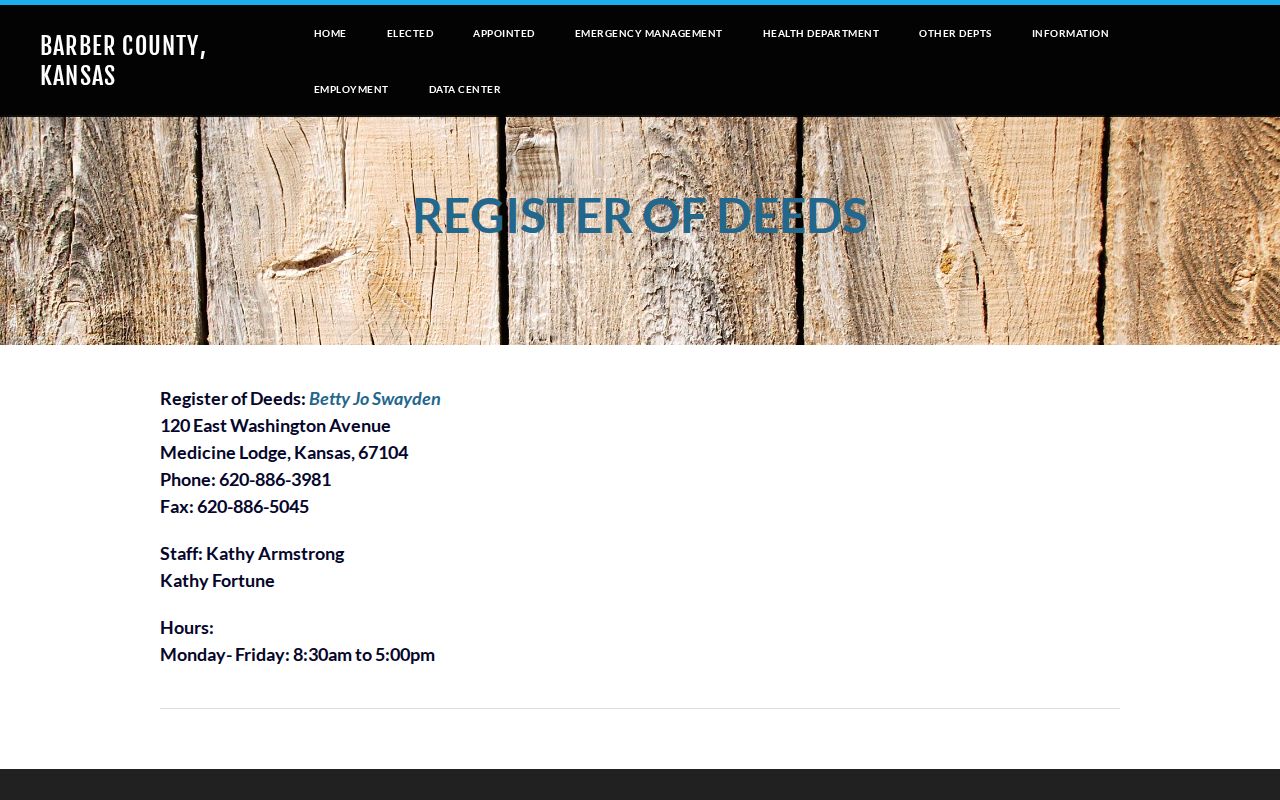
The Barber County Register of Deeds page names the responsible office and lists its contact channels. It also makes clear why no online deed index should be assumed.
Build a Barber Deed Request
The online CIC parcel search supplies the raw material for a focused deed request. Search by address or current owner. Open the blue Owner Information number. Copy the PIN, Quick Ref, legal description, situs, and any sale date shown. Rural descriptions often run section-township-range. City parcels usually cite subdivision, block, and lot. Keep the exact punctuation and portal spelling when you copy.
Ask the Register for the instrument recorded to the current grantee. Also ask for its recording date and reference. For a past chain, ask how the office organizes its direct and reverse indexes. A broad request for everything wastes staff time. A narrow request tied to one legal description and date range is easier to search. It is also easier to price.
- Current and earlier owner or entity spellings
- PIN, OLD_PIN, and Quick Ref when available
- Full lot, block, subdivision, or rural legal description
- Approximate sale or recording date
- Requested output, such as index reference, plain copy, or certified copy
Trace Barber County Deeds Backward
The grantor transfers an interest. The grantee receives it. To rebuild a Barber County chain of title, start with the instrument to the current grantee. Read the named grantor. Then find the deed by which that grantor earlier received the same legal description. Keep walking backward one transfer at a time. Match the land and recording references at every step. One person may have owned several tracts in the county.
- Use the parcel roll to identify the current grantee spelling and exact land description.
- Request the latest deed and record its grantor, grantee, date, deed type, and book/page or instrument reference.
- Search the latest grantor as an earlier grantee, then match the same legal description.
- Repeat while noting correction deeds, probate transfers, sheriff's deeds, releases, and name variants.
- Move to office indexes, deed books, plats, or KSHS sources when the modern trail ends.
- Grantor
- The party transferring the stated interest.
- Grantee
- The party receiving that interest.
- Chain of title
- The linked sequence of recorded transfers for the same land.
- Book/page or instrument number
- The office reference used to retrieve a recorded document.
No Verified Barber Deed Index
Barber County publishes no online deed index and states no online cutoff year. Do not quote a start date from another Kansas county. Do not treat the CIC sale panel as a substitute either. The appraiser system identifies a tax parcel and may show sale data, while the Register of Deeds holds the recorded instrument and its official indexing details.
Phone and counter access remain the primary routes. Mail works well too, when the legal description and the document sought are specific. When an ordinary office request will not fit, the Barber County KORA request form allows a written request for identifiable, nonexempt material, with advance payment and itemized fees. KORA's third-business-day rule is an initial response deadline, not a promise of final delivery.
Unknown cutoff. No verified first online year exists in the source set. Older and newer Barber County deed records should be confirmed directly with the Register.
Barber and Barbour Name Variants
Old deed research in this county hides a spelling trap. Barber County carried the spelling "Barbour" until 1883, honoring the same man, Thomas W. Barber. Anyone tracing early deeds should search both spellings across catalogs, newspapers, maps, and archive descriptions. Personal names drift too, through initials, marriage, estates, and business successors. Indexing habits changed over the decades as well. A modern owner-name query will miss many early grantees.
The Kansas Historical Society land-record guide notes that tract books are organized by legal description, not by name. Tract books are not indexed by name. For rural ground, section-township-range links a modern parcel number to early land entries. Tract books can list purchaser, acreage, price, date, and governing law. Later private transfers lead back to the Barber County deed chain held by the recorder.
Barber Deeds Meet Historic Atlases
KSHS lists Barber County property-ownership atlases from 1905 and 1923. An atlas freezes ownership at one date. It cannot replace the deed records themselves, but it can still earn its keep. A plat page can place a surname in the right township. It can also pin down a road, town addition, cemetery, or school. That detail untangles an old legal description.
Check the Barber County atlas finding aid before you plan an archive visit.
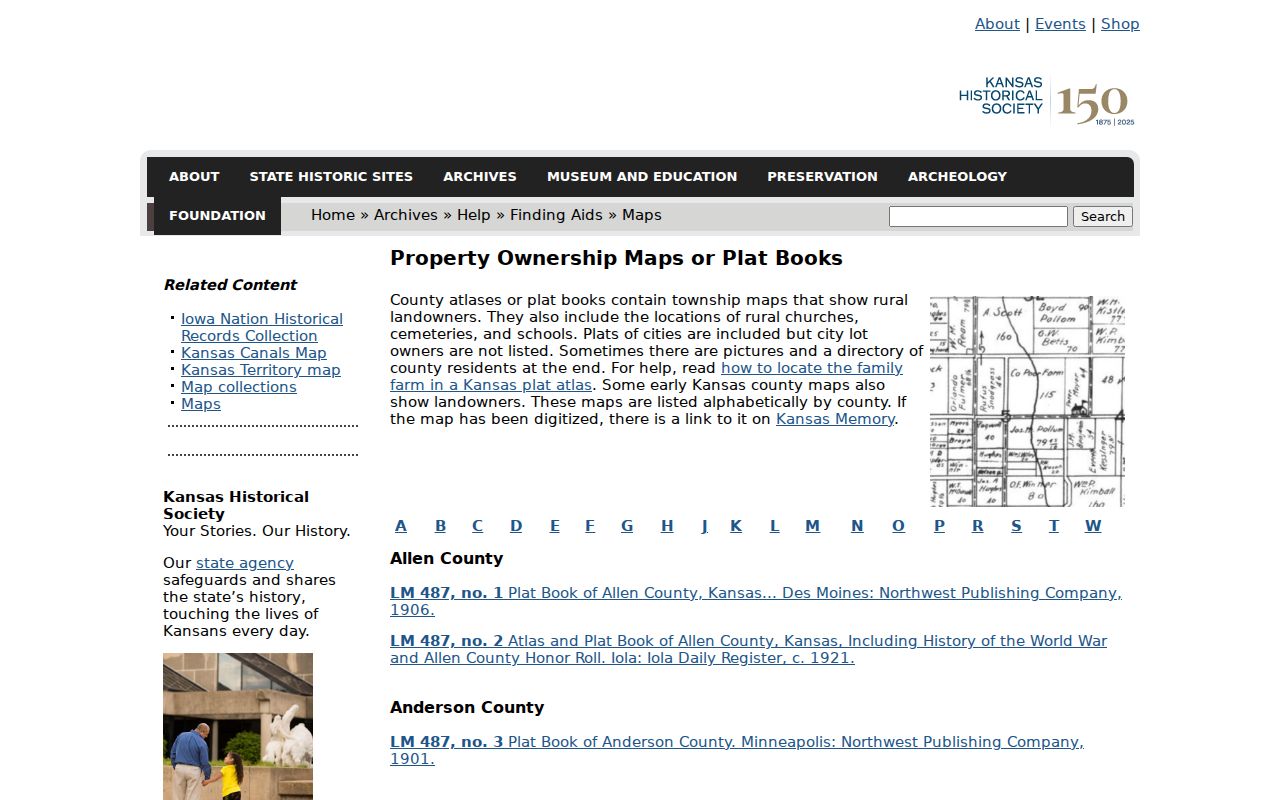
The finding aid ties family names to particular editions, while the deed books and index references in the recorder's office establish each actual transfer. Use the two together. Note: Treat an atlas label as a lead only, then confirm the same land in the recorded deed chain before you rely on it.
Obtain a Barber County Deed Copy
Request a Barber County deed copy from the Register by counter visit, telephone, or mail. Say up front whether a plain copy will do or a certified copy is required. Give the exact instrument reference when you have it. Otherwise supply the grantor and grantee. Add the recording range, the legal description, and the parcel keys. The official sources publish no copy or certification fee. Ask the office for the current charge and an estimate before you order.
When the office responds, keep the retrieval details together. Record the staff contact, the request date, and the source index. Note the reference used. Also note whether any volume or image was missing. Need a certified copy for a formal transaction or case? Say so at the start. The general Barber County property search workflow helps assemble the parcel identifiers. Only the recorder supplies the recorded deed itself.
Recorded, not guaranteed. A Barber County deed proves that an instrument was recorded. It is not a title opinion, and later, conflicting, or unrecorded interests may require professional review.