
Read Barber County Property Tax Records
Reading Barber County property tax records means working across two systems that do different jobs. The Appraiser sets parcel facts and valuation. The Treasurer keeps tax statements, tax years, and current or delinquent status. A careful reader matches the same CAMA number, Quick Ref, tax ID, owner or taxpayer name, and legal description. Match them across both offices. Treat neither figure as the other. An appraised value is not a tax amount. A tax search result is not proof of market price.
The tax portal reaches beyond real estate, too. Its tax-type menu covers personal property, oil, gas, trucks, minerals, and state-assessed utilities. Choose Real Estate when the question concerns land and improvements. Note the type and year alongside whatever result you keep.
| Field | What It Shows | Where |
|---|---|---|
| Appraised value | County estimate used before the statutory assessment rate | Appraiser parcel record |
| Assessed value | Tax base after classification and assessment rules | Appraiser record |
| Tax year | Year attached to the statement or query | Treasurer tax search |
| Current or delinquent status | Whether a returned statement falls in the selected balance filter | Treasurer tax search |
| Tax ID and parcel keys | References that connect the statement to land | Tax and parcel systems |
Sale consideration, appraised value, assessed value, and the bill are four different evidence points. Blending them causes confusion. Classification and the local levy drive how a parcel is taxed. A deed or sale field may document a transaction. The tax record documents administration for one stated year.
Names deserve the same care. The tax portal lets a searcher pick Current Owner, Taxpayer, or Both. That choice itself shows the roles are not always identical. A mailing recipient, an entity, an estate, or a prior taxpayer should never be labeled the legal owner. Check the current parcel roll and the latest deed records first. Note which name-match mode you selected, so another reader can reproduce why a statement appeared.
Barber County Tax Search Options
The CIC Treasurer tax search is the main online route for Barber County tax records. It displays a database status of August 31, 2026. That figure reflects the application, not every historical year. Search options run wide. CAMA, taxpayer identification, year range, tax unit and parcel number, name, address, subdivision, block, lot, section-township-range, lease name, and Quick Ref all work as entry points.
| Tax field | Format or choice | Best use |
|---|---|---|
| Tax Type | RL, PP, OL, GS, TK, MN, or SA | Select the correct tax roll |
| Name Match Type | Current Owner, Taxpayer, or Both | Separate ownership from billing name |
| Tax Identification | Three-digit unit plus ten-digit parcel | Match a known statement |
| CAMA | Eight segmented parts | Translate an appraisal key |
| Balance filters | Current taxes or taxes due | Narrow statement status |
| Property criteria | Address, subdivision, tract, lease, Quick Ref | Find the parcel without a tax ID |
When a search format fails, open the official tax-search help. It recommends shorter name terms and documents the Find Now and Reset controls.
Barber CAMA Has Eight Parts
CAMA is a portal quirk that rewards exact transcription. The tax form splits it into MAP, SEC, SHT, QTR, BLK, PRE, and SUF boxes. OWN takes a separate box of its own. All eight parts are required for that direct mode. A tax identification number works differently. It uses a three-digit tax unit plus a ten-digit parcel number. Keep leading zeroes and field labels in your notes so the key stays reproducible.
- Appraised value
- The county's estimate before the assessment rate is applied.
- Assessed value
- The taxable base produced under classification and assessment rules.
- Mill levy
- The combined rate applied in calculating tax, expressed through taxing authorities.
- Tax lien
- A legal claim tied to unpaid tax, which is not proved by a search screen alone.
The Quick Ref is often the easiest bridge. It carries a parcel detail straight into a tax query. If one format fails, return to the appraiser detail, confirm the parcel, and follow its current or previous Tax Info link.
Look Up a Barber County Tax Bill
Start a Barber County property tax lookup with the strongest identifier you have. An address works. But the county Quick Ref, tax ID, or CAMA key gives an exact match. Set the year range and select the Real Estate tax type. The "taxes due" filter deserves caution. It serves an outstanding-balance question and can omit statements outside that condition.
- Choose Real Estate and enter a Quick Ref, CAMA, tax ID, name, address, or legal tract.
- Set the starting and ending tax years and decide whether a balance filter fits the question.
- Open the result and record the tax type, year, tax ID, parcel key, owner or taxpayer role, and displayed status.
- Compare the parcel with the appraiser record and legal description.
- Ask the Treasurer for a certified statement or lien-related record when legal reliance matters.
- Taxpayer
- The name associated with taxation, which may differ from Current Owner.
- Current taxes
- The portal's filter for current-year statements.
- Taxes due
- A filter for statements showing current or delinquent balances.
- Taxing unit
- The jurisdiction code that forms part of the tax identification.
Inspect the live Barber County tax form before choosing filters.
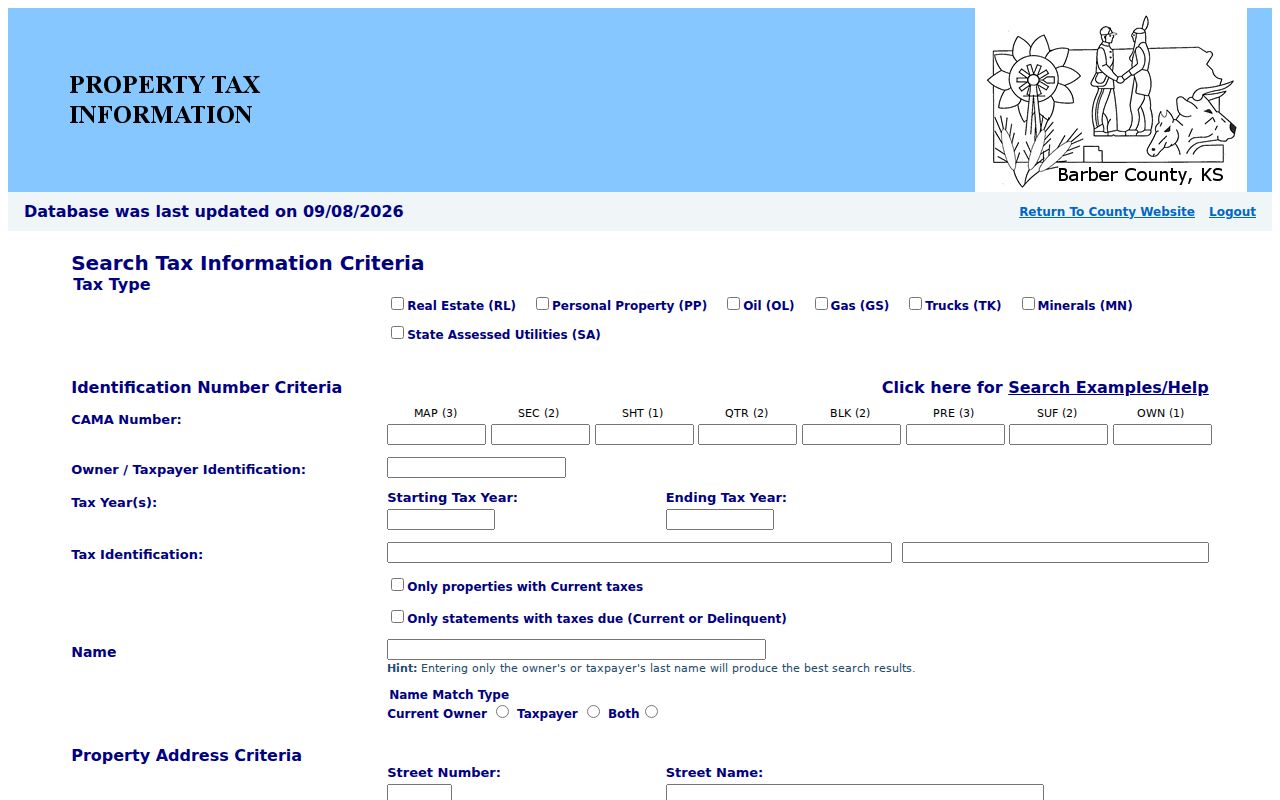
Capture tax type, year, name role, and parcel format.
Barber Tax Values Are Distinct
The Barber County Appraiser defines fair market value as the amount a well-informed buyer would pay. A well-informed seller would accept that amount. The market stays open. Kansas tax administration then applies rules tied to property classification. Agricultural land follows state use-value methods instead. The assessed value that emerges is still not the levy-based bill that arrives later.
Read the figures in sequence: appraised value, assessment treatment, taxable or assessed amount, applicable levy. The final item is the tax statement. Exemption or classification status can shift the taxable result. Nothing physical about the property changes. For valuation terms in depth, the Barber County property value page breaks them down. The tax record remains the authority for the bill and its status.
Barber County 2025 Market Study
The county study supports the 2026 valuation cycle. It reported residential movement of roughly one to five percent overall. Vacant land showed no discernible trend. Commercial and industrial property was mixed, again with no clear direction. Agricultural updates drew on Kansas Department of Revenue and Kansas State University data under K.S.A. 79-1476.
These are class-level findings, not predictions for any single parcel. Neighborhood, quality, condition, age, and market evidence can move one property differently. For the current notice and study, visit the Barber County Appraiser page.
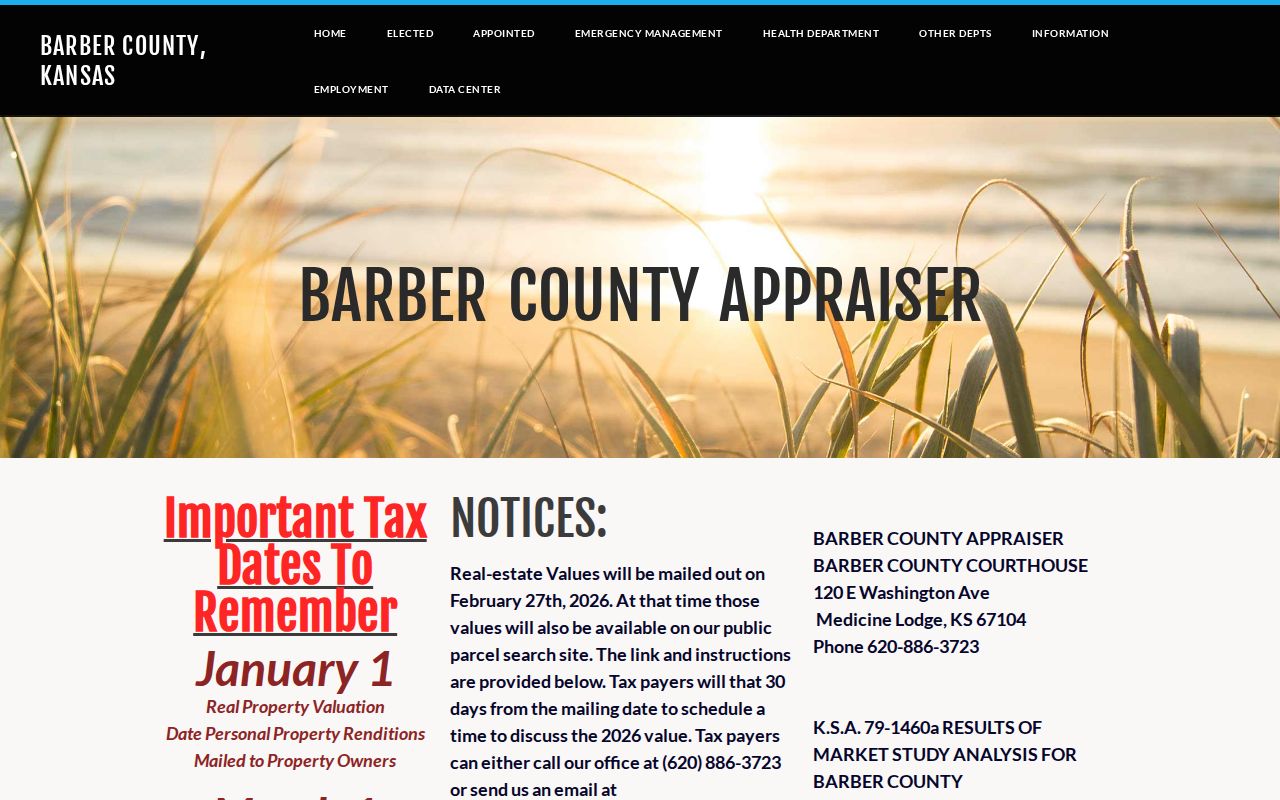
The county notice connects valuation evidence to the 2026 discussion window. It also names the proper office route for appeals and questions.
Note: A countywide trend is context only; compare the subject parcel's record and its supporting market evidence.
Request Missing Barber Tax Records
Skip the screen and go straight to the source. Treasurer Sheri J. Weeks keeps the Barber County office at 118 E Washington Avenue in Medicine Lodge, open weekdays from 8:30 a.m. to 5 p.m. Call 620-886-3775. Call with the tax year, tax type, parcel number, and the output you want. Ask plainly. You may need a simple statement or a payment history. You may also need a delinquency record or a certified copy.
The portal does not cover everything. For the rest, the county posts a January 2025 KORA form. Copies run 25 cents per black-and-white page and 50 cents for color. Staff time carries its own rate, and advance payment is allowed. You can also request an itemized statement. The office answers as soon as possible. It responds by the third business day, but full production can take longer.
Contest a Barber County Assessment
Barber County mailed its 2026 real-estate value notices on February 27, 2026. Values also went up on the parcel site. An owner has 30 days from the mailing date to schedule a value discussion. Before calling the Appraiser, check the parcel number, classification, characteristics, legal description, and value evidence. Know which office handles your issue. Tax-bill disputes go to the Treasurer; valuation disputes start with the Appraiser.
The county's forms and information page links protest forms, an informal questionnaire, payment-under-protest material, and Kansas Board of Tax Appeals details. Pick the form that matches your stage of the dispute and its deadline.
Thirty-day discussion window. For the 2026 notice, Barber County gave owners 30 days from mailing to schedule a value discussion. Confirm the live deadline for any later cycle.
Evidence wins appeals, and it should be parcel-specific. Gather the notice, photos, factual corrections, comparable sales, and notes from office contacts. A broad market-study trend will not decide a single appeal.
Keep records after the discussion too. Note the notice date, the evidence submitted, and the office response. Also record the next review level the county identified. Payment under protest is a separate procedure the county links separately. An informal value discussion does not automatically preserve every later remedy. Confirm current deadlines for the tax year at issue.