
The Barber County Owner-of-Record Card
Start with the Barber County CIC appraiser search. It is the quickest way to check who owns a parcel now, and its owner line sits beside mailing and situs addresses plus the stable parcel keys that keep the result tied to one tract.
| Owner Name | Person, estate, trust, or entity carried on the roll |
|---|---|
| Owner Address | Destination used for county notices |
| Situs Address | Physical parcel location |
| PIN / Quick Ref | Keys that join GIS, property, and tax results |
| Legal Description | Land identity used to confirm a deed |
| Sale Fields | Transfer clues that still require instrument review |
The roll never proves who lives there. Farms, vacant tracts, estates, and business parcels often carry a mailing address far from the situs, sometimes because notices go to an owner who receives mail elsewhere. The CIC parcel detail names that record type.
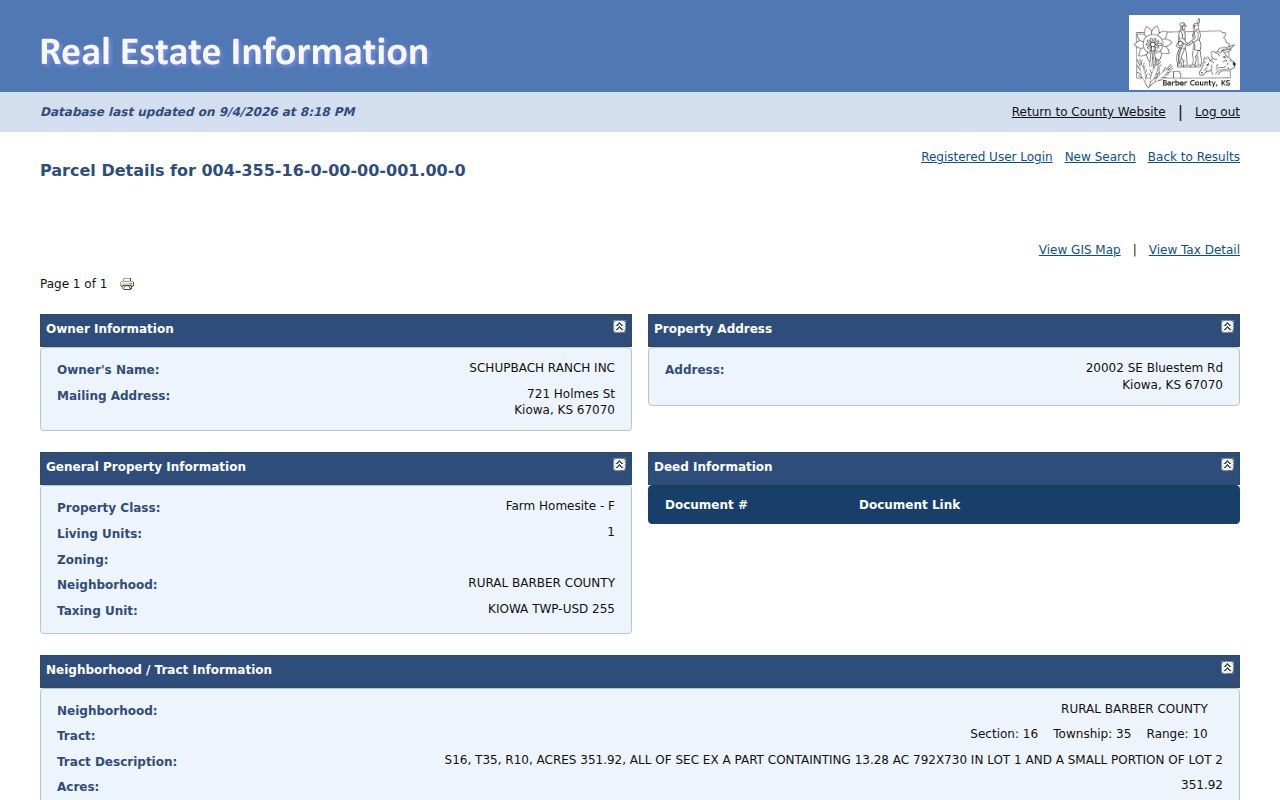
A name means little on its own. Read the owner beside the legal description and the parcel identifiers rather than treating the name as a standalone answer.
OwnerName, OwnerAddr, and SitusAddr in Barber GIS
The county parcel service exposes these three fields plus PIN, Quick Ref, legal description, and links to the CIC and tax pages. OwnerName is the roll name. OwnerAddr is for mail, and SitusAddr locates the parcel. Check all three in the Barber County GIS parcel layer.
Note: A mailing address is a contact clue, not proof that the current owner lives at that location.
When a New Deed Is Ahead of the Roll
The county sets no fixed posting lag. CIC displays an update date, though a deed recorded after that refresh may name a newer grantee. Check the source dates first.
Recent transfer. The assessment roll can trail a newly recorded conveyance; use the newest valid deed to confirm the current owner.
PIN and Quick Ref Confirm the Current Parcel
A name alone makes a poor key. Relatives share surnames, entities hold several tracts, and the same road number can appear in more than one locality. CIC accepts Parcel ID, Quick Ref, CAMA, legal description, sale date, property class, acreage, and subdivision searches. Save the identifiers. Carry them into GIS, tax, and deed questions so every later lookup points to the same tract. The county GIS service exposes the same values with direct CIC and tax links, letting the roll entry be matched to the mapped land.
Rural ground favors the legal description. Section, township, and range outlast a road address. For a platted city parcel, subdivision, block, and lot do the same work. Attach the owner to that parcel identity. A loose address match proves far less.
Taxpayer and Current Owner Are Separate Ideas
The Barber County tax search offers taxpayer and name criteria, plus address, CAMA, tax year, tax ID, subdivision, lot, block, section, township, range, lease name, and Quick Ref. A taxpayer search can find the account. Its name should not displace the owner-of-record question. A prior owner, fiduciary, or differently formatted entity name can linger on the account during a transition.
Keep the roles apart. Each source answers a different question. Use the tax page to corroborate the parcel, the appraiser OwnerName for the roll entry, and the latest recorded deed for confirmation. That discipline keeps an account name from passing as certified title.
Note: Match the tax result by PIN or Quick Ref before comparing its taxpayer name with the current owner.
The Medicine Lodge Route for a Fresh Transfer
The Register of Deeds sits at 120 E Washington Avenue in Medicine Lodge. Hours are 8:30 to 5:00, Monday through Friday. The phone is 620-886-3981. The office publishes no online grantor-grantee index. Counter, telephone, and written requests fill that gap when a recent transfer must be verified.
Give staff the exact roll name. Add the PIN or Quick Ref, the legal description, and the approximate closing date. Ask for the latest recorded conveyance and its citation. The county's January 2025 KORA form offers a written route with possible copy and staff charges, electronic-format discretion, and advance payment, so confirm costs and delivery with the office.
Read LLC, Trust, and Estate Names Literally
A company parcel may list the entity itself. Search that exact string in the Kansas Secretary of State database. The public search takes an entity name, a Kansas SOS business ID, or a current resident agent. It returns only the first 200 matches. A resident agent is a contact, not the owner.
Preserve trustee names, dates, initials, and executor or estate wording when requesting a deed or probate record. Never collapse a fiduciary into a beneficial owner. The record card gives the current public name; the recorded instrument explains how that interest arrived.
An exact-name search also separates a live company from a similarly named or forfeited one. Record the entity ID and status. Then return to the deed. Registration data explains the public company contact. It does not certify the parcel's title or reveal every person holding an economic interest in the land.
A Reproducible Current-Owner Check
Date every source you consult. Note the appraiser roll's update date. Note the GIS access date as well. Record the recording date of the newest deed you reviewed. Then write the conclusion in source-specific language: the appraiser roll lists a named owner of record, GIS links that name to the mapped parcel, and the newest deed names a grantee. That phrasing keeps the gap visible.
When sources disagree, work through a set order of checks. Verify the PIN, Quick Ref, and legal description first. Then see whether the deed postdates the roll update. A transaction can also cover several tracts, only part of the current parcel, or an interest rather than the whole estate. A corrected deed, a probate filing, or an entity conversion may explain why the names differ. Resist choosing the newest-looking screen for convenience.
Keep office inquiries narrow. Broad surname requests rarely help. Provide the parcel description, the approximate transaction date, and the current roll name. Some questions outgrow the record card: a certified ownership opinion, competing interests, or an unrecorded claim calls for qualified title assistance. This audit trail keeps a Barber County current-owner result useful for purchase research and property correspondence, without overstating what the county portal certifies.
Save the result as a dated official snapshot, not an evergreen claim. Owner records can change overnight. A later conveyance, correction, court order, or parcel split can shift the owner of record. Label the roll update and deed recording behind it. Recheck the source before any new transaction.
Confirm the Current Barber County Owner
Go past the parcel card to the recorded deed.
- Search CIC by address; save the exact owner name, PIN, Quick Ref, and legal description.
- Confirm the mapped parcel in Barber County GIS.
- Contact the Register of Deeds at 620-886-3981 for the newest deed affecting the description.
- Compare its grantee and recording date with the current roll entry.
- Owner of record
- The party currently carried on the assessment roll.
- Recording lag
- The interval before a transfer appears in another county system.
- Registered agent
- A statutory entity contact, not necessarily its property owner.
Entity Owners and Protected Kansas Addresses
LLC owners take one extra step. Search the exact roll name in the Kansas business-entity database. Preserve trust and estate wording for deed review, and remember that Kansas Safe at Home may substitute a protected mailing address, keeping public address data intentionally limited.
Lawful use. Use owner information for legitimate property correspondence and research, never to stalk, harass, intimidate, or harm anyone.