
Compare Barber County Value Types
The CIC appraiser record should be read by valuation year and property class.
| Value | What It Is | Where |
|---|---|---|
| Appraised value | County mass-appraisal estimate for the stated year | CIC and value notice |
| Assessed value | Appraised value multiplied by the Kansas assessment rate | Appraiser and tax record |
| Sale price | Consideration associated with a transfer, subject to verification | Sale field and recorded deed |
| Land and improvement values | Components explaining how the total is allocated | Parcel detail when displayed |
Kansas classifies property before taxing it. Residential real property is generally assessed at 11.5 percent, commercial and industrial at 25 percent, vacant lots at 12 percent, and agricultural land at 30 percent of use value. Confirm the classification first.
From Barber County Appraisal to Assessment
Appraised value times the assessment rate equals assessed value. Tax then depends on the mill levy as well. Two Barber County parcels with identical appraisals can owe different amounts when they sit in different taxing units. Payments and levy details belong in property tax records.
Note: Compare values from the same tax year and class before drawing a conclusion about relative worth.
The 2025 Barber County Market Study
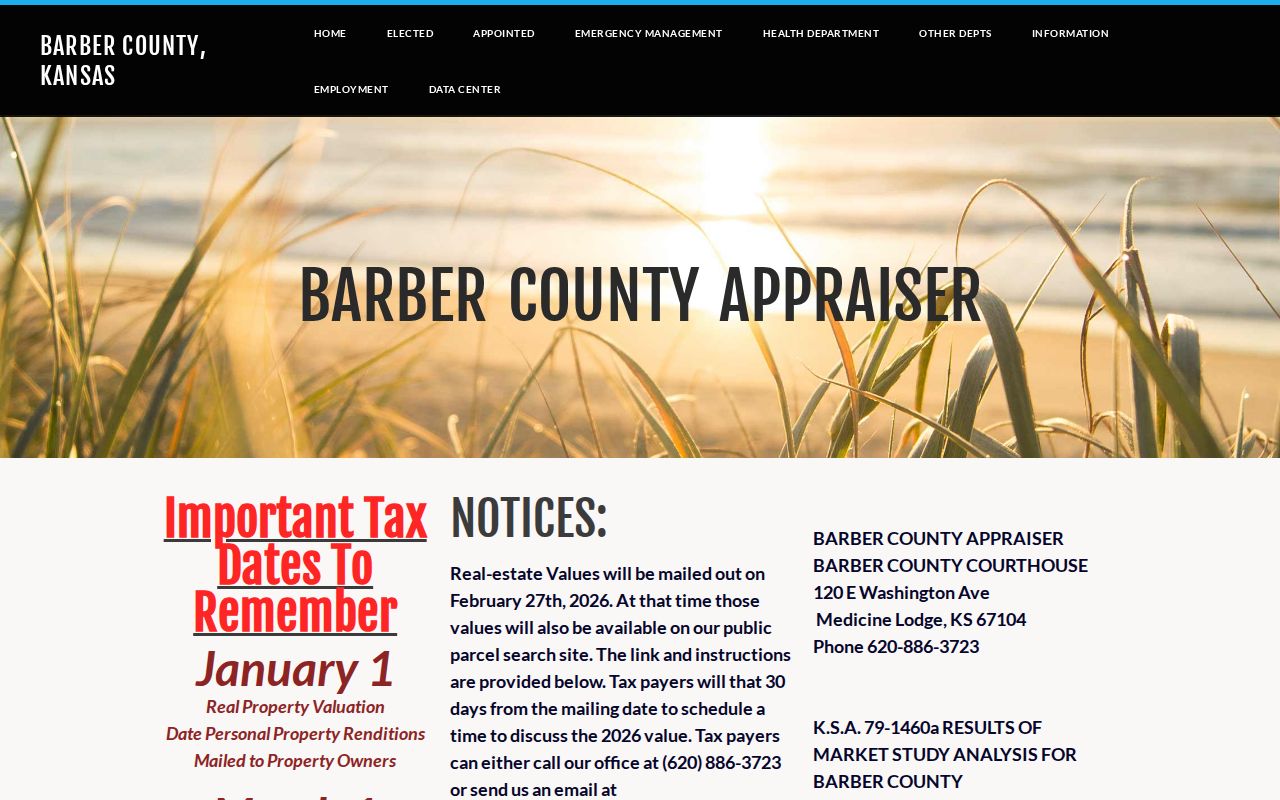
The Barber County Appraiser covers value changes in its 2025 market study. Residential property moved generally 1 to 5 percent. Vacant land stayed stable, with no discernible trend. Commercial and industrial data came in mixed, also without an overall discernible trend. For agricultural land, values rest on Kansas Department of Revenue and Kansas State University data under K.S.A. 79-1476. The official appraiser page carries the current notice and the value-review context for each parcel.
Those are broad study findings, not parcel-specific answers. One parcel can move differently. Condition, classification, land use, new construction, data corrections, or local sales evidence can each shift a Barber County parcel's outcome. The county appraiser's office is the route for interpreting the annual notice and asking about a specific appraised figure.
Property Class Changes the Barber County Assessment
Kansas has no single assessment rate for real property. Residential property is generally assessed at 11.5 percent of appraised value, commercial and industrial property at 25 percent, vacant lots at 12 percent, and agricultural land at 30 percent of use value. Comparisons need matching class and year. Agricultural use value diverges sharply from a sale-price estimate. Barber County's market-study material points to Kansas Department of Revenue and Kansas State University data under K.S.A. 79-1476. Acreage, use, soil, and productivity inputs can matter more than a nearby residential sale. Never multiply a farm's sale price by a residential rate. That is not a county assessment. Check CIC's class and acreage fields. Contact the appraiser with the parcel number and supporting facts. A wrong class deserves that call. Classification questions concern how the county applies the statutory framework, while sale-price questions concern a transaction. Keep those questions separate.
Recorded Sale Evidence Is a Different Value Point
CIC offers sale-date search modes, and parcel details may carry sale history. A displayed sale figure is not automatically market value. The transaction may be old. It may involve related parties, several parcels, unusual financing, or personal property. Verify the deed and its exact legal description with the Register of Deeds first. Barber County publishes no online grantor-grantee index. Call 620-886-3981 or visit the office at 120 E Washington Avenue in Medicine Lodge, Monday through Friday, 8:30 a.m. to 5:00 p.m. Ask for the conveyance and any instrument citation. Coverage and copy charges change, so confirm them with the office.
For comparisons, use sales from a relevant period. Match class, use, acreage, location, and improvements too. One last sale can anchor a question, but it cannot explain the whole appraised-value model.
The 2026 Barber County Value Notice Window
Barber County mailed its 2026 real-estate value notices on February 27, 2026. The notices also appeared on the parcel site. Owners had 30 days from the mailing date to schedule a discussion. The mailing date controls that window. Check the parcel's own notice instead. Don't assume one calendar deadline for every later question. Preparation makes the call count. Assemble the PIN or Quick Ref, legal description, valuation year, property class, and land and improvement components. Name the specific fact believed wrong. Photographs, a survey, corrected measurements, relevant sales, or classification documents all help. Keep the argument on the county value and its inputs.
The county forms and information page links protest materials, an informal questionnaire, payment-under-protest information, and Kansas Board of Tax Appeals resources. Those procedures review an assessment; they do not change the deed's grantee or guarantee a sale price.
Mill Levies Explain Why Value Is Not the Tax Bill
Assessed value is only one input. The mill levy does the rest of the work. It turns that figure into an actual tax bill. Two neighboring parcels can carry nearly identical appraised values yet receive very different bills. They sit in different taxing units, or they hold different classifications and exemptions. The county GIS adds taxing-unit and district context so you can see which jurisdiction applies.
Pull the bill itself through the CIC tax search. It accepts Quick Ref, CAMA, taxpayer, tax year, tax ID, name, address, subdivision, lot, block, or section-township-range. Confirm the result belongs to the right parcel before comparing any figures. Barber County property value splits into three distinct steps. Appraisal estimates the property. Assessment applies the statutory class rate. The levy calculates tax. A recorded sale price stands apart from all of it as independent market evidence.
Build a Barber County Value Comparison Workbook
Start with the subject parcel. Record its PIN, Quick Ref, legal description, and property class. Include acreage, valuation year, appraised value, and assessed value. Note any land and improvement components. Then give every sale used as evidence its own line. List the date, price, legal description, class, acreage, and source. This layout keeps unlike numbers from blending into one misleading estimate.
Screen out sales from a different valuation year or classification unless the adjustment is explicit. A commercial parcel assessed at 25 percent cannot sit beside an 11.5-percent residential assessment. Agricultural use value is not an open-market estimate, so treat it differently. A multi-parcel sale may need allocation before it tells you anything about one current PIN.
Changes between the sale and the current appraisal matter too. A lot split, combination, demolition, new construction, or a legal-description correction can explain a large gap. Either historical figure may still be right. Keep the deed recording citation with the worksheet.
The finished comparison should frame a range of evidence, not promise an exact selling price. For a tax-review question, work from the county's valuation inputs and the timely procedure. For a purchase or sale decision, add current condition and a qualified market analysis to the public record. Barber County records supply a disciplined factual base. But they cannot inspect the property or predict what two private parties will accept.
Estimate a Barber County Property Value
Keep record values separate while assembling the comparison.
- Search CIC by address, PIN, Quick Ref, owner, subdivision, or legal description.
- Record the appraised and assessed values, valuation year, class, acreage, and available land/improvement split.
- Check sale fields, then confirm the transfer through the Register of Deeds.
- Compare like properties and the same valuation year.
- Assessed value
- The appraisal after the statutory class rate.
- Appraised value
- The county's mass-appraisal estimate.
- Sale price
- A transaction evidence point, not the current appraisal.
What Barber County's Appraised Value Does Not Promise
A county value is a mass-appraisal figure built for tax administration. It is not a forecast of the next contract price, and it is not a parcel-specific private appraisal. Sale terms, date, condition, personal property, and unusual financing can all make a reported price weak comparison evidence.
Value versus price. A Barber County assessed or appraised value does not guarantee what a property will sell for; obtain qualified valuation help when the decision requires it.
For 2026, value notices went out February 27. Owners then had 30 days from that mailing to schedule a discussion. That deadline governs contesting the county valuation, not changing a recorded sale price.